

Dual-Wavelength Commutator-Based Photometry System
The Dual-Wavelength Photometry System incorporates new features based on customer feedback.
The Plexon Commutator Photometry System is a dual-wavelength camera-based system for use with freely-behaving animals. A branching patch cable enables simultaneous recording up to four different regions. The system stimulates with blue (465nm) light and uses UV (410nm) light as an isosbetic control signal. The fluorescence is measured with a camera, which allows up to four fibers to be measured at the same time.
Dual-Wavelength Commutator-Based Photometry System
The Dual-Wavelength Photometry System incorporates new features based on customer feedback.
The Plexon Commutator Photometry System is a dual-wavelength camera-based system for use with freely-behaving animals. A branching patch cable enables simultaneous recording up to four different regions. The system stimulates with blue (465nm) light and uses UV (410nm) light as an isosbetic control signal. The fluorescence is measured with a camera, which allows up to four fibers to be measured at the same time.
Dual-Wavelength Commutator-Based Photometry System
This camera-based system with commutator includes two built in LEDs for excitation and one optical sensor which allow for detection of green fluorescence and a branching patch cable provides the user with the ability to record from multiple brain regions. The system interleaves the 410 nm and 465 nm LEDS and the camera detecting green fluorescence captures light for each of these wavelengths independently, which allows the user to identify the calcium-dependent fluorescence (isosbestic control).
System Features
- The Inertial Measurement Unit IMU commutator enables smooth, artifact-free rotation with no optical joint
- Capture neural activity in freely behaving animals and minimizes degradation and tethering constraints
- LED scheduler reduces risk of photobleaching by configuring ON/OFF schedule for LEDS
- Record from multiple locations in a single animal
- Detect fluorescence at 525 nm using one detection camera
- Align photometry signals with behavioral events using digital inputs
- Integrated video tracking software
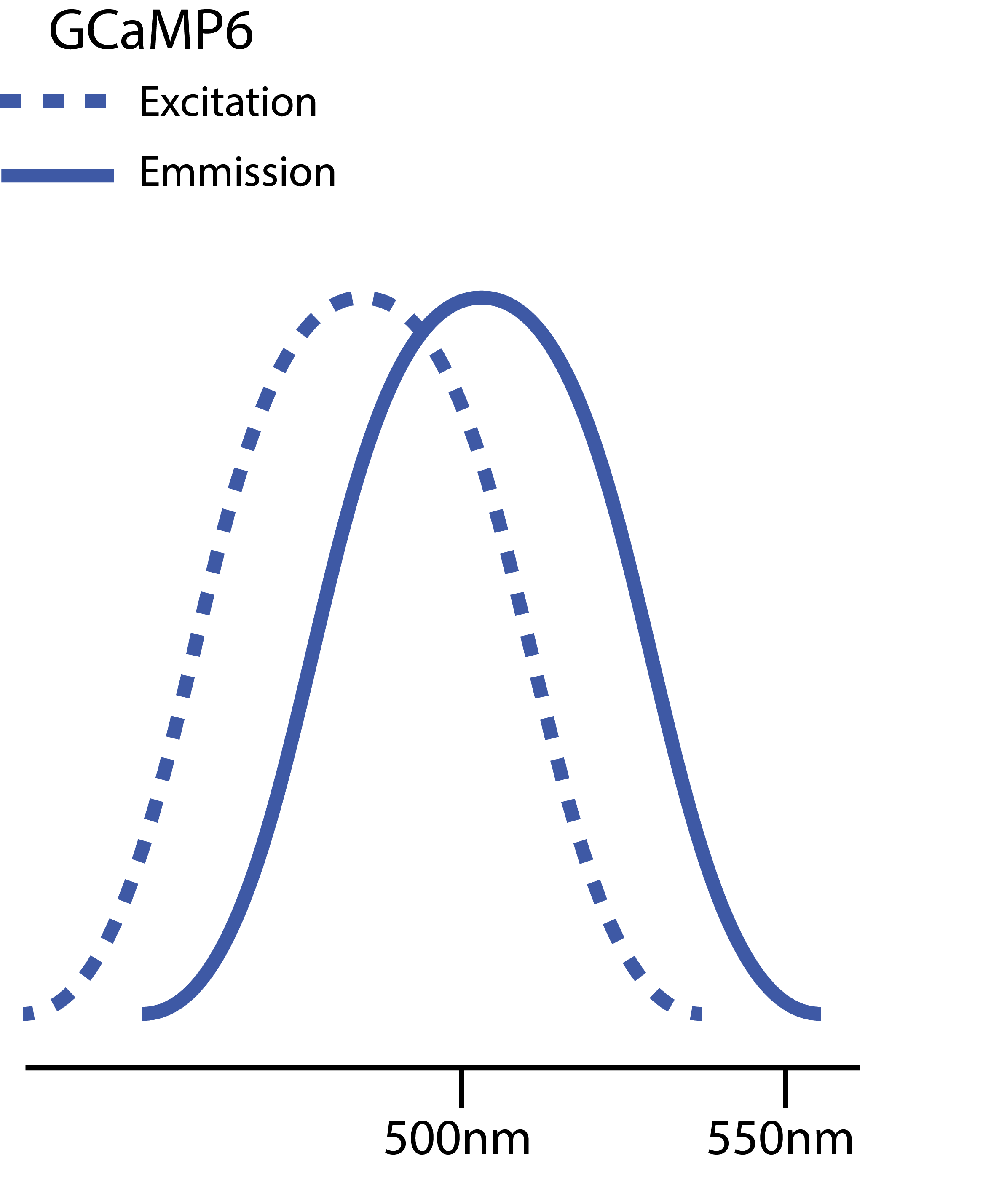
465 nm for selectively activating GCaMP6
410 nm for use as an isosbestic control to detect calcium-independent signals
Selected technical specifications for Plexon’s Multi-Wavelength Photometry system are provided below. A Plexon Sales Engineer is happy to discuss your needs and how this product could best support your research goals.
Photometry Module
| Excitation wavelength | 410 nm, 465 nm |
| Detection wavelength | 505-545 nm |
| Number of Fibers | Up to 4 |
| LED driver | Yes, two high current LED drivers |
| Trigger Interfaces | Yes, one camera trigger interfaces |
| Digital Inputs | 12 |
| Digital Outputs | 12 |
| Timing Interface | Yes |
| SPI Interface | Yes |
| Commutator | Yes |
Behavioral Camera
| Resolution | 640 (H) x 480 (V) |
| Max frame rate at full resolution | 30fps |
Installation Packages/Upgrades
Change Log
- Multi-Wavelength Photometry Change Log Post date August 2025
Technical Specs and Data Sheets
- Dual-Wavelength Photometry Data Sheet
- Patch Cable Alignment
- Dual-Wavelength Photometry Quick Start Guide
- Dual-Wavelength Photometry User Guide - Coming Soon
Support Videos
- Multi-Wavelength Multi-Fiber Photometry Quick Start Tutorial
- Multi-Wavelength Photometry Demo
- Multi-Wavelength Photometry: Tracking Behavior On Previously Recorded File
- pMAT vs GuPPY: Multi-Wavelength Photometry Open-Source Parts 1-4
- Neurophotonics Summer School 2022: Kristin Marquardt, PHD discusses photometry data analysis using pMAT and GuPPy
Additional Info
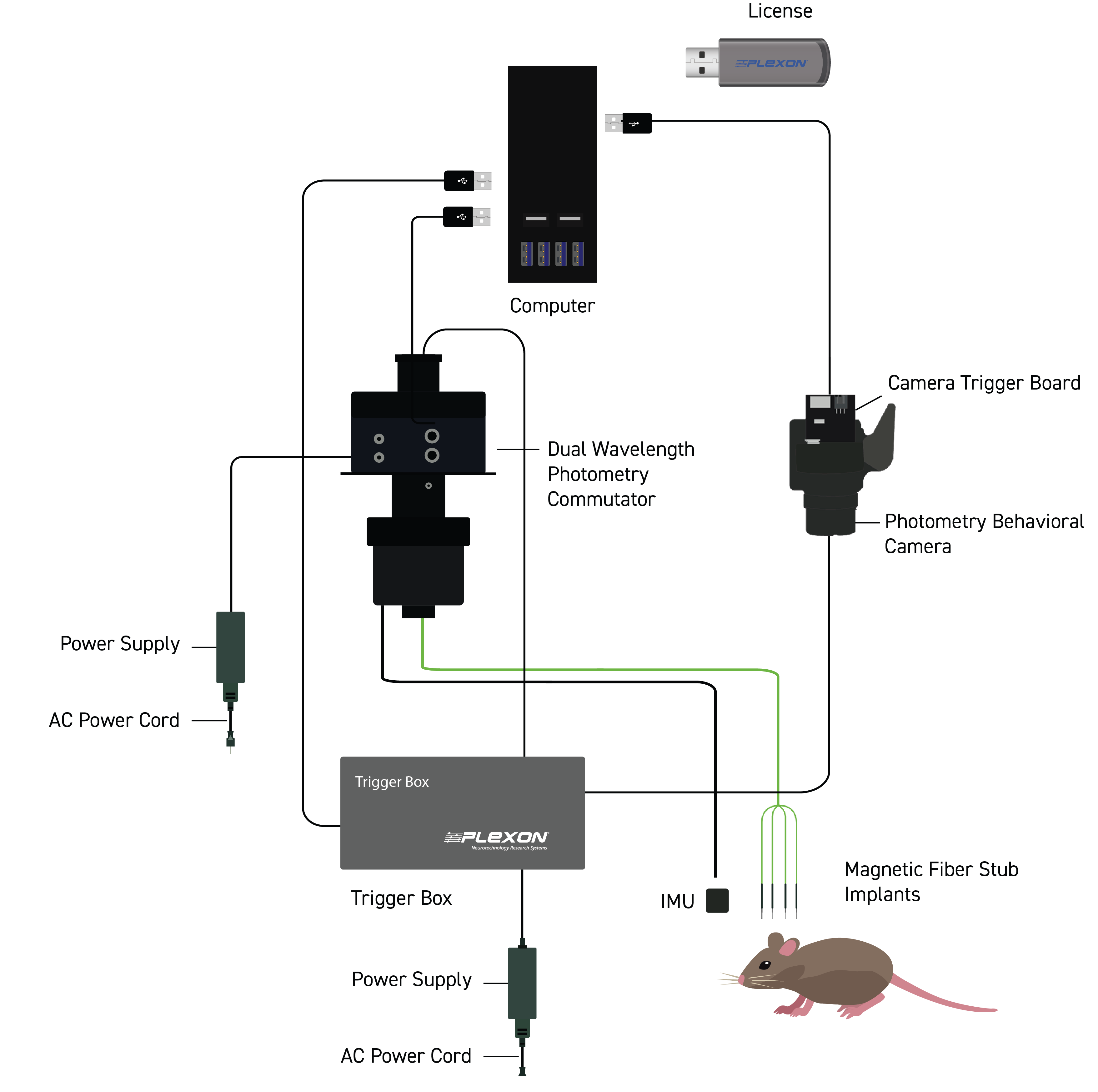
Dual-Wavelength 4-fiber Commutator-Based Photometry System
This camera-based system with commutators includes two built in LEDs for excitation and one optical sensor which allow for detection of green fluorescence and a branching patch cable provides the user with the ability to record from multiple brain regions or multiple animals. The system interleaves the 410 nm and 465 nm LEDS and the camera detecting green fluorescence captures light for each of these wavelengths independently, which allows the user to identify the calcium-dependent fluorescence (isosbestic control).
System Features
- The Inertial Measurement Unit IMU commutator enables smooth, artifact-free rotation with no optical joint
- Capture neural activity in freely behaving animals and minimizes degradation and tethering constraints
- LED scheduler reduces risk of photobleaching by configuring ON/OFF schedule for LEDS
- Record from multiple locations in a single animal
- Detect fluorescence at 525 nm using one detection camera
- Align photometry signals with behavioral events using digital inputs
- Integrated video tracking software
465 nm for selectively activating GCaMP6
410 nm for use as an isosbestic control to detect calcium-independent signals
for Plexon’s Multi-Wavelength Photometry system are provided below. A Plexon Sales Engineer is happy to discuss your needs and how this product could best support your research goals.
Photometry Module
| Excitation wavelength | 410 nm, 465 nm |
| Detection wavelength | 505-545 nm |
| Number of Fibers | Up to 4 |
| LED driver | Yes, two high current LED drivers |
| Trigger Interfaces | Yes, one camera trigger interfaces |
| Digital Inputs | 12 |
| Digital Outputs | 12 |
| Timing Interface | Yes |
| SPI Interface | Yes |
| Commutator | Yes |
Behavioral Camera
| Resolution | 640 (H) x 480 (V) |
| Max frame rate at full resolution | 30fps |
Installation Packages/Upgrades
Change Log
- Multi-Wavelength Photometry Change Log Post date August 2025
Technical Specs and Data Sheets
- Dual-Wavelength Photometry Data Sheet
- Patch Cable Alignment
- Dual-Wavelength Photometry Quick Start Guide
- Dual-Wavelength Photometry User Guide- Coming Soon
Support Videos
- Multi-Wavelength Multi-Fiber Photometry Quick Start Tutorial
- Multi-Wavelength Photometry Demo
- Multi-Wavelength Photometry: Tracking Behavior On Previously Recorded File
- pMAT vs GuPPY: Multi-Wavelength Photometry Open-Source Parts 1-4
- Neurophotonics Summer School 2022: Kristin Marquardt, PHD discusses photometry data analysis using pMAT and GuPPy
Additional Info