
Electroencephalography (EEG) and electromyography (EMG) are techniques used in a wide range of animal research disciplines to investigate brain function, muscle activity, and their involvement in health and disease. Researchers might use EEG to study brain waves and patterns of electrical activity in animals to better understand sleep states, arousal, cognition, movement disorders, epilepsy, and sensory processing. In addition, EMG can be used concurrently to assess muscle activity during specific behaviors or tasks.
A question asked of Plexon with increased regularity is whether the OmniPlex System can be used to record EEG or EMG signals. The OmniPlex System is commonly used to acquire wide band, spikes, and local field potential signals, but there has been an increased interest in acquiring EEG and EMG signals at the same time. The short answer is yes—Plexon has several customers and OmniPlex System user labs actively using the system to acquire EEG and / or EMG data. There are two different options for acquiring EEG or EMG data with OmniPlex, which will be both addressed here.
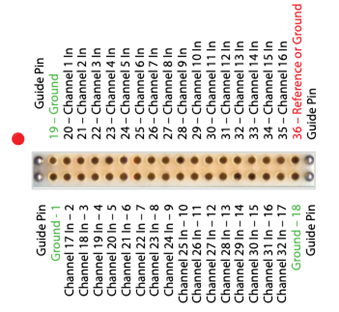
Traditional 32 channel digital headstage
The most common option (and arguably the easier option) is to use either a traditional digital 8, 16, 32, 64, or 128 channel headstage with a dedicated ground and reference input to acquired EEG.
The benefit of using a traditional headstage is one or more likely already exist in the lab and was included with the system when purchased. Using a traditional headstage, the EEG electrodes and a common ground or reference electrode can be used as the point of reference and signals within a traditional EEG bandpass can be processed with the OmniPlex system.
Here is an image of the pinout of a traditional 32 channel digital headstage from Plexon. EEG wires could be interfaced to the channel inputs (E.g., Channel 1 In, Channel 2 In, etc.) and the ground connection to the electrode could be interfaced to the Ground and / or Refence or Ground inputs. See “Grounding and Referencing for Electrophysiology Recording Systems” on the Plexon blog for more information on selecting a ground or reference input.
It is also possible to use the OmniPlex System to record EMG signals; however, Plexon’s digital 16 channel differential (DIFF) headstage is recommended.
The DIFF headstage has a 32 channel input connector, yet records only 16 channels total. Each channel has a channel input (+) and dedicated reference input (-). The signal on the dedicated reference input is subtracted from its corresponding channel. The recorded signal is the difference between what is acquired on the input and what is acquired on the reference. This differential scheme is common for EMG signal acquisition. Here is an image of the DIFF headstage input pinout. Notice each channel has a + and – input.
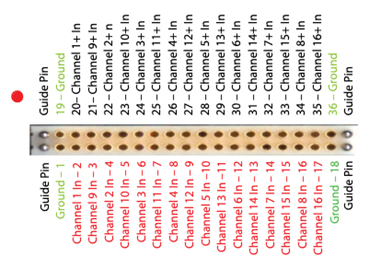
Each channel has a + and – input.
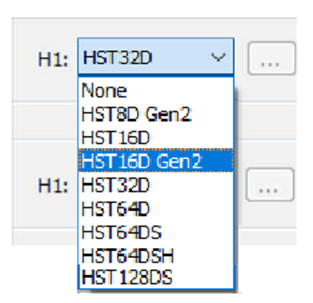
When using the DIFF headstage, the HST16D Gen2 option must be selected in the headstage option dropdown menu in OmniPlex Server. With the DIFF headstage in OmniPlex, 16 channels are recorded. E.g., Channel 1 as displayed in OmniPlex is the amplified difference between the input pins marked Channel 1+ and Channel 1-.
Another option for acquiring EEG or EMG signals with OmniPlex is to use the auxiliary analog input panel (AuxAI) likely installed in the OmniPlex chassis.

auxiliary analog input panel (AuxAI)
While this method is less common, it does offer some benefits compared to the more common and traditional methods already described. One benefit of using the AuxAI is it does not consume channels within the OmniPlex digital headstage processer (DHP). For example, using a 64 channel OmniPlex System with an AuxAI subsystem, 16 channels of EEG data could be acquired with the AuxAI along with 64 channels of wideband data from the DHP. Another benefit of the AuxAI method is the user can take advantage of the powerful AuxAI Filter (AIF) functionality built into the OmniPlex software. With the AIF feature, highpass and lowpass filters can be set for the signals acquired with the AuxAI.
Utilizing this feature will create a new data variable within the recorded pl2 file specific to the EEG and / or EMG signals acquired with the AuxAI. One drawback of the AuxAI method is it requires hardware not typically included with the OmniPlex System. The AuxAI is solely a means of acquisition, and thus an analog headstage, amplifier, etc. is required to process the front-end EEG or EMG signal pre-acquisition. Plexon offers analog front-end hardware for EEG and EMG processing (see the Biopotential headstage options on the Plexon website). Additionally, not all OmniPlex Systems are configured with the AuxAI, which may mean an upgrade is required to utilize this method.
There are many ways to use the OmniPlex System outside of traditional wideband and spike acquisition. As research questions and focus change, Plexon has changed its focus to accommodate its users and customers. If you have questions about a non-traditional way to use the OmniPlex System, please get in touch with Plexon.

Written by Andrew Klein