
Plexon Research Spotlight
Kerem Çatalbaş
Sweeney Lab at University of Illinois Urbana-Champaign
What type of neuroscience research do you do and what got you interested in this research?
An important aspect of my work is its focus on female physiology, particularly during states like pregnancy and lactation—unique to females. Studying these physiological states is crucial because they involve distinct metabolic and hormonal changes that significantly impact behavior and energy regulation. Unfortunately, research on female physiology remains underrepresented in neuroscience, so I'm very proud to contribute to filling this gap by highlighting sex-specific differences in brain function. My research aims to emphasize the importance of studying these stages, as they provide invaluable insights into the neural circuits underlying feeding behavior.
What challenges did you encounter along the way, and how did you overcome these challenges?
One of the major challenges in my research was obtaining consistent and reliable data from in vivo imaging of AgRP neurons. Early on, we struggled with signal reliability and fiber placement for photometry experiments. By refining our surgical techniques, improving viral targeting of specific neurons, and optimizing the setup of the Plexon Multi-Wavelength Photometry System, we were able to overcome these obstacles. Furthermore, balancing behavioral assays with complex in vivo recording techniques was another challenge, but careful experimental design helped mitigate these issues.
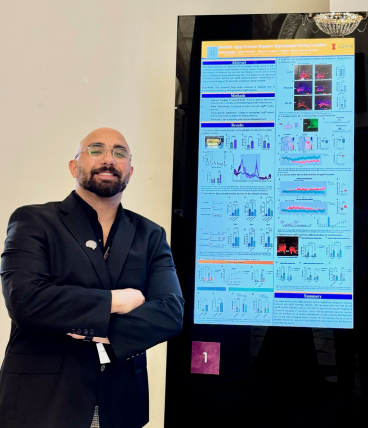
Do you have a recent publication or abstract that you would like to share?
Plexon Product Used
Plexon Research Spotlight
Sweeney Lab at University of Illinois Urbana-Champaign
What type of neuroscience research do you do and what got you interested in this research?
An important aspect of my work is its focus on female physiology, particularly during states like pregnancy and lactation—unique to females. Studying these physiological states is crucial because they involve distinct metabolic and hormonal changes that significantly impact behavior and energy regulation. Unfortunately, research on female physiology remains underrepresented in neuroscience, so I'm very proud to contribute to filling this gap by highlighting sex-specific differences in brain function. My research aims to emphasize the importance of studying these stages, as they provide invaluable insights into the neural circuits underlying feeding behavior.
What challenges did you encounter along the way, and how did you overcome these challenges?
One of the major challenges in my research was obtaining consistent and reliable data from in vivo imaging of AgRP neurons. Early on, we struggled with signal reliability and fiber placement for photometry experiments. By refining our surgical techniques, improving viral targeting of specific neurons, and optimizing the setup of the Plexon Multi-Wavelength Photometry System, we were able to overcome these obstacles. Furthermore, balancing behavioral assays with complex in vivo recording techniques was another challenge, but careful experimental design helped mitigate these issues.
Do you have a recent publication or abstract that you would like to share?
Plexon Product Used