
As artificial intelligence (AI) advances, its potential to aid in various stages of scientific publishing has sparked interest and debate within research communities. From helping with literature reviews to generating summaries or even suggesting edits, AI offers promising tools for streamlining the publication process. A recent analysis found that “one percent of scientific articles published in 2023 showed signs of generative AI’s potential involvement.”1 But as we consider these tools, it’s important to weigh both the potential benefits and concerns surrounding their use in research neuroscience publications.
Potential Benefits
One of AI’s biggest appeals is its ability to process large amounts of data quickly, which can be a tremendous help when researchers need to stay up-to-date with the ever-growing body of literature. AI tools can efficiently scan and summarize relevant studies, identify key findings, and even generate visual aids like graphs and charts, saving researchers hours of manual work. Additionally, AI-driven language models can assist in improving grammar, structure, and clarity, especially for researchers who may not be native English speakers.
By reducing the time spent on these tasks, researchers can focus more on the actual science behind their work, potentially speeding up the publication process and making findings available more quickly.
Studies have shown that papers incorporating AI methods are more likely to be highly cited, indicating a broader impact within the scientific community. Research indicates that “papers with titles or abstracts that mention certain artificial intelligence (AI) methods are more likely to be among the top 5% most-cited works in their field.”2
Concerns About AI in Publishing
Despite these benefits, there are concerns about relying on AI in research publications. A major concern is the potential for AI to introduce or amplify biases, as algorithms can inadvertently mirror biases found in the data they are trained on. This could mean overlooking important but less-studied topics, skewing results, or misinterpreting data.
The integration of AI chatbots like ChatGPT into scientific publishing has raised significant concerns. Scientific American highlights the potential misuse of these tools, noting that “researchers are misusing ChatGPT and other artificial intelligence chatbots to produce scientific literature.”1 Researchers and editors also worry about the accuracy and ethical implications of AI-suggested content; AI systems are prone to “hallucinations,” or generating plausible but incorrect information.
There is also the question of authorship and originality. If AI contributes significantly to the writing or structuring of a paper, it raises complex questions about who should be credited and how the publication should reflect these contributions. Transparency around AI use is critical, as misrepresentation of AI-assisted work could affect the credibility and integrity of scientific publishing.
Authenticity and Tone of Scholarly Writing
The use of AI in publications raises important questions about its impact on the authenticity and tone of scholarly writing. One concern is that AI-generated content may lack the natural variation found in human authorship.
While AI can efficiently produce text based on patterns in large datasets, this can lead to a more uniform and less dynamic style compared to the unique voices and perspectives that human authors bring to their work. As Andrew Gray, a librarian and researcher at University College London, notes, “When you’ve looked at this stuff long enough, you get a feel for the style.”1
The image below, sourced from Scientific American, offers a closer look at how these patterns emerge in AI-generated text, contributing to the ongoing discussion about the role of AI in scientific publications.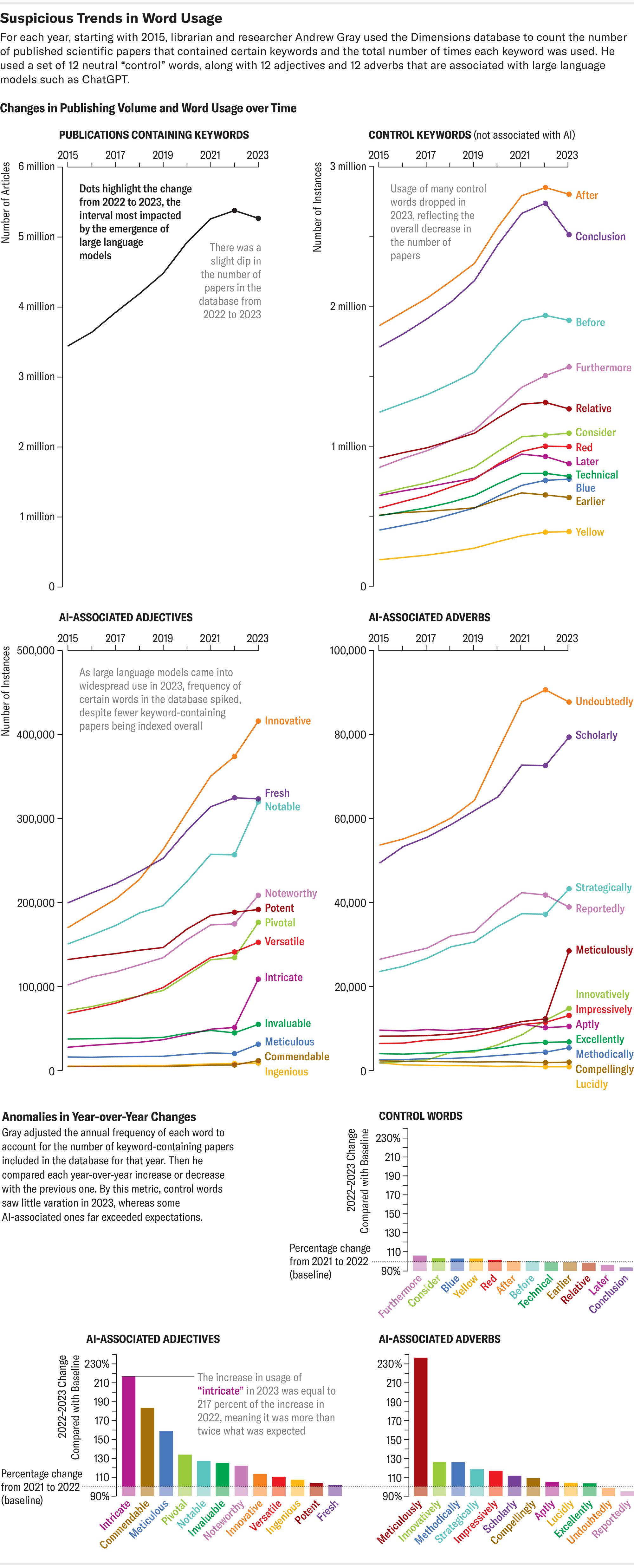
Balancing Innovation and Integrity
As the field of neuroscience explores these new tools, a balanced approach may offer the best path forward. AI could be used to enhance, but not replace, the research and writing process, and clear guidelines can help ensure transparency. Many journals now encourage authors to disclose any AI involvement, which adds an element of accountability and lets readers assess the role AI played in the publication.
Ultimately, whether AI should be used in research neuroscience publications is a complex question. While it has potential to support researchers, maintaining rigor and integrity in scientific communication remains essential. Ongoing discussions around best practices and ethical guidelines will help shape a responsible path forward.
Disclaimer: The writing of this blog post involved AI tools to aid in content development and clarity.
References
- Stokel-Walker, Chris. “AI Chatbots Have Thoroughly Infiltrated Scientific Publishing.” Scientific American, 1 May 2024
- Gao, Jian, and Dashun Wang. “Quantifying the Use and Potential Benefits of Artificial Intelligence in Scientific Research.” Nature Human Behaviour, 11 Oct. 2024

Written by Alyssa Wright-Brown